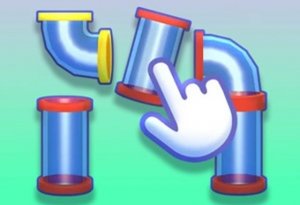
Rotating Pipes to Complete the Path
Pipe Connect: Logic Puzzle is a browser-based puzzle game built around a single action: rotating pipe segments. Each piece turns when you tap or click it, and the objective is to arrange every segment so they form one unbroken route from the water source to the drain. Visual cues confirm when a connection is made, so you can track progress as you work. The interaction is simple enough to learn in seconds, but the underlying logic requires planning rather than reflex.
From Small Grids to Branching Routes
Early puzzles use compact grids with only a few pieces, giving newcomers room to understand rotation without pressure. As you advance, grids expand and pipe configurations grow more tangled. Some levels add multiple branches, which means you must think several moves ahead instead of fixing one section at a time. The difficulty rises gradually, so the game stays challenging without becoming frustrating. That balance makes it suitable for short breaks or longer sessions.
Clean Interface and Cross-Device Controls
The interface keeps distractions low. Pipe segments are clearly drawn, and distinct icons mark the water source and drain so you can identify start and end points at a glance. Controls work with both mouse and touch input, which means the same puzzle plays smoothly on desktop computers, tablets, and smartphones. Because everything runs in a modern browser, there is no installation step and no setup time.
Planning Over Random Clicking
Success depends on observation and deliberate choices. A common approach is to scan the whole board first, locate the source and drain, then work backward to sketch a possible route. Another method is to build the main pathway before adjusting side branches. The game rewards patience rather than rapid tapping, and each solved puzzle delivers a clear sense of completion.
Procedural Layouts and Saved Progress
Every level presents a unique arrangement of pipe pieces, so no two puzzles feel identical. A progression system unlocks new level sets as you finish earlier ones, providing steady feedback. Because layouts are generated procedurally, replaying a completed level can produce a different configuration, which adds replay value beyond the initial solve. Progress saves automatically, letting you stop at any point and resume later without losing your place.


Comments
0 comments