How the Guessing Works
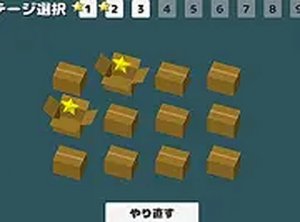
Star Guessing Puzzle strips the memory-game format down to a single clean loop. A star is placed under a piece of cardboard. The cardboard shifts, and you must decide where the star has moved. There are no timers, no penalties, and no elaborate rule set to learn. The entire challenge rests on whether you watched closely enough to follow the star's position through the movement.
The interface keeps everything visible. A top button switches between stages, and a bottom button repeats the current stage. After the cardboard moves, a save button appears at the bottom right, letting you store progress for later. These controls are the full extent of the interaction, which is why the game works the same way for a child trying it for the first time and an adult looking for a quick mental exercise.
Stage Progression and Difficulty
The game uses a stage progression system that gradually raises the difficulty. Early stages give you a manageable amount of movement to track. Later stages demand more focused attention as the cardboard's path becomes harder to follow. Because you can repeat any stage, the difficulty curve never becomes a wall. If a particular arrangement of movements throws you off, the repeat button lets you study it again before moving forward.
Progress can be saved, so a session does not have to be completed in one sitting. That matters for a game built on short bursts of concentration. You can play a few stages, save, and return when your attention is fresh.
Design and Accessibility
The visual design is deliberately plain. A clean background, a clear cardboard shape, and an obvious star keep the focus on tracking movement rather than parsing clutter. This is a practical choice for a game about observation: anything decorative would compete with the thing you are supposed to watch. The friendly, uncluttered look also makes it suitable for younger players without feeling condescending to adults.
Star Guessing Puzzle runs in a web browser and requires no download or installation. It is built for mouse or keyboard input on desktop, with full screen mode available for a larger view. Touch devices may also work, though the primary control scheme is desktop-oriented. There is no time pressure and no complex control scheme, so the game is accessible to a wide range of ages and skill levels.
Who It Suits
This is a game for players who want a short, low-stakes mental break rather than a long campaign. The appeal is the same as a classic memory exercise: you either tracked the star or you did not, and the result is immediate. Players who enjoy gradual improvement, repetition, and the satisfaction of sharpening a specific skill will get the most from it. Those looking for story, characters, or fast action will find the experience too minimal.
Comments
0 comments