Merging Meets Physics
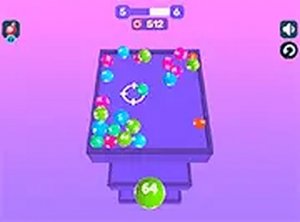
Merge Balls 2048 Puzzle takes the number-matching idea behind 2048 and places it inside a 3D play area where balls behave like physical objects. Instead of sliding tiles across a grid, you drop balls from above. Each ball carries a number and a color. When two balls with the same number and color collide, they merge into a single larger ball. That single action is the core of every decision you make.
Reading the Board Before Each Drop
Because balls settle according to physics rather than snapping to fixed cells, the board state changes in ways you cannot fully predict. A ball might roll slightly after landing, nudging a neighbor into a merge you did not plan, or it might wedge into a gap and block future drops. This unpredictability is the game's main challenge. You are not solving a static puzzle; you are managing a shifting pile. The goal is to keep merging for a higher score while preventing the play area from filling up. The game ends when no room remains for a new ball.
Controls and Accessibility
You control the game with a mouse or keyboard, choosing where to drop each ball. There is no time pressure between drops, so you can study the board before committing. That design choice makes the game approachable for newcomers while still rewarding players who think several moves ahead. The simple premise—drop, merge, score—is easy to grasp, but the spatial reasoning required to sustain long sessions gives it depth.
Visual Style and Session Length
Colorful 3D graphics give the balls a tangible presence, and the physics interactions add a layer of realism that makes each drop feel distinct. The game is built for desktop play and runs in a browser without downloads. Sessions can be as short as a few minutes or stretch longer, depending on how carefully you play. The combination of strategy and relaxation suits players who want mental engagement without frantic action.




Comments
0 comments