What You Actually Do
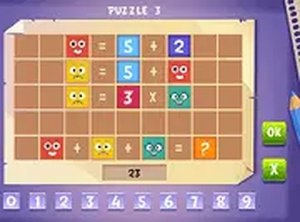
Each puzzle presents a set of visual patterns, and every pattern stands for an unknown number. You are given equations that combine these patterns using addition, subtraction, multiplication, or division. Your job is to work out which number each pattern represents. There are no hidden tricks beyond the arithmetic and the relationships shown in the equations.
How Difficulty Scales
Puzzles are not all the same size. Early ones tend to involve fewer patterns and simpler operations, so you can learn how the equations fit together. Later puzzles introduce more patterns or require you to solve one equation before you can use its result in another. The game does not lock you into a fixed sequence; you can start with easier levels and move on when the logic feels comfortable.
Controls and Session Flow
You play with a mouse or keyboard on a desktop browser. There is no timer and no penalty for pausing, so you can leave a puzzle half-finished and return to it. A full-screen mode is available if you want a larger view of the patterns and equations. The interface is deliberately plain, which keeps attention on the numbers rather than on decorative elements.
Who It Suits
This is a quiet, self-paced game for people who enjoy mental arithmetic and deductive reasoning. It works as a short break or a longer session, and because it does not rely on reflexes or reaction speed, it is equally playable for younger users and adults. The lack of a time limit makes it a low-stress way to practice basic operations without the pressure of a countdown.


Comments
0 comments