Game Introduction
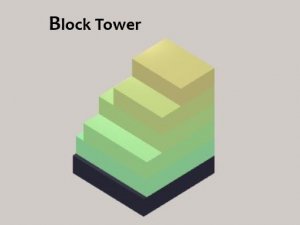
Precision Stacking Challenge is a casual puzzle game centered around the simple yet engaging task of building a tower. Players are presented with a single block that slides horizontally across the screen. The objective is to tap at the right moment to place the block on top of the growing stack. Each successful placement adds a new layer, while a misaligned block falls away, ending the round. The game’s appeal lies in its straightforward premise and the satisfying loop of trying to beat your personal best. As the tower rises, the blocks move more quickly, requiring sharper focus and quicker reactions. This creates a gentle but persistent difficulty curve that keeps the gameplay fresh. The clean, minimal design ensures that players can concentrate entirely on the stacking action without distractions. It is a title that welcomes newcomers while offering enough depth for those seeking to refine their skills. The experience is about patience and precision, making it a relaxing yet mentally stimulating activity. There are no complex narratives or characters to manage; the focus remains purely on the act of stacking. This simplicity is a core strength, allowing for short play sessions that can easily extend into longer periods of focused play. The game is designed to be accessible, with no need for prior experience or knowledge of game mechanics. It stands as a pure test of hand-eye coordination and timing, rewarding steady improvement and concentration.
How to Play
In Precision Stacking Challenge, the core interaction is a single tap. A new block appears and begins moving back and forth above the current tower. Players must observe the block’s movement and tap the screen when it is directly aligned with the top of the stack. If the block is placed accurately, it becomes part of the tower, and a new block begins moving. The challenge comes from the increasing speed of the block’s movement as the tower gets higher. A mistimed tap causes the block to fall off, and the game resets to the first block. There are no other controls or menus to navigate during play. The entire experience is built around this simple timing mechanic. Players quickly learn that consistent success requires a calm approach and careful observation. The game does not require any special equipment or prior training, making it easy for anyone to start playing immediately. The feedback is immediate: a successful placement feels satisfying, while a miss provides a clear lesson in timing. This loop of attempt, success, or failure is the entire gameplay cycle.
Game Features
Precision Stacking Challenge offers a core set of features that are evident from its gameplay. The primary feature is the simple tap-to-place control scheme, which is easy for anyone to learn. The game presents an endless stacking mode, where the goal is to build as high as possible without a predetermined limit. A key feature is the gradual increase in block speed as the tower grows, which adds a natural layer of difficulty. The visual design is clean and uncluttered, focusing the player’s attention on the moving block and the tower. The game is designed to be family-friendly, with content suitable for all age groups. The core loop is highly replayable, as each round offers a new chance to improve. The experience is self-contained, with no external purchases or complex systems to manage. The game provides a satisfying sense of progression through personal score improvement. It is optimized for short, focused play sessions, making it a good choice for quick breaks or longer periods of concentration.
Tips for Success
To improve in Precision Stacking Challenge, focus on developing a steady rhythm. Watch the block’s movement pattern closely and try to anticipate its position. Avoid rushing your taps; a calm, deliberate approach often yields better results. Regular practice will naturally improve your timing and accuracy. If you make a mistake, treat it as a learning opportunity and try again. The key is to stay patient and concentrate on each individual placement rather than worrying about the final height.





Comments
0 comments